Skip to content
(347) 262-9435

Consumer Legal Tech

Live

Collector Audit

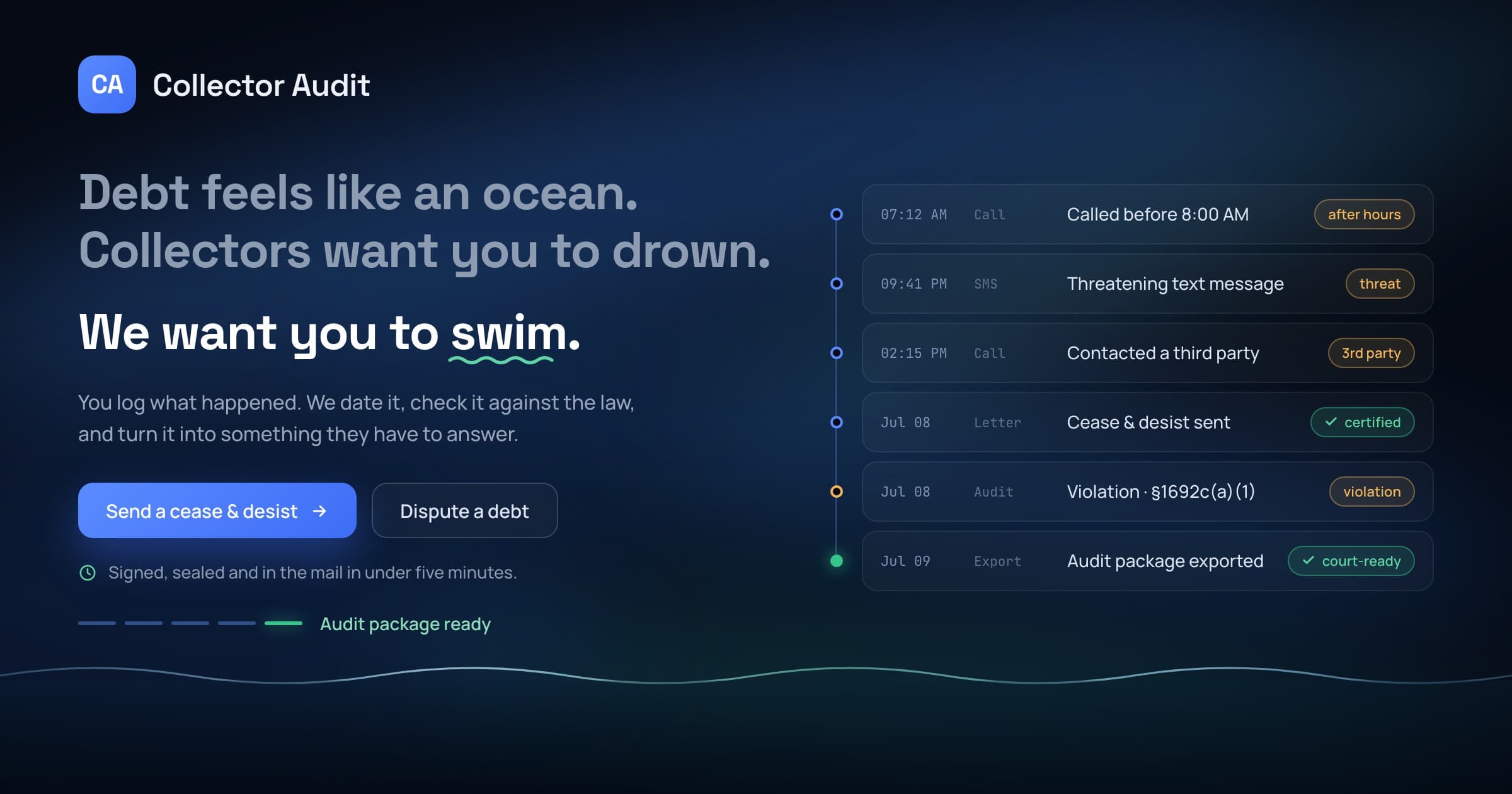
Debt feels like an ocean. Collectors want you to drown. We want you to swim.

  • Next.js
  • TypeScript
  • Postgres
  • Document pipeline
Collector Audit — Debt feels like an ocean. Collectors want you to drown. We want you to swim.

The problem

What this is for

Consumer protection law only helps people who can prove what happened. The Fair Debt Collection Practices Act gives real leverage — statutory damages, a cease-contact right, a validation right — but exercising it means producing dates, times, numbers and what was said, and the person being called is rarely keeping a log while it happens. The result is a real violation that cannot be evidenced.

Statute-cited rules
8

FDCPA and Regulation F

Letter templates
3

Validation, dispute, cease contact

How letters go out
Certified

With tracking and delivery confirmation

How it works

In the order you meet it

Consumer protection law only helps people who can prove what happened. Collector Audit gives that leverage back: every call, voicemail, text, and letter is logged with a timestamp into a tamper-evident vault, and built-in checks flag contacts that appear to breach the Fair Debt Collection Practices Act. When it is time to act, the workspace produces FDCPA-aligned letters, sends them by tracked certified mail, and exports a structured PDF for an attorney or a regulator.

  1. 01

    Log the contact while it is fresh

    Calls, voicemails, texts, emails and letters, each timestamped. Screenshots and recordings attach to the entry, and their hash is computed in the browser before upload so the file's identity is fixed at the moment it was added.

  2. 02

    The log is checked against the statute

    A rules engine flags contacts that appear to breach the FDCPA and Regulation F, each finding citing the section it comes from — after-hours contact, third-party disclosure, contact after a cease letter, continued collection after a validation request, and the seven-calls-in-seven-days frequency rule among them.

  3. 03

    Send something they have to answer

    Validation, dispute and cease-contact letters are generated from the log and dispatched as real certified mail through a print-and-mail provider, with tracking and a delivery webhook that records what happened to it.

  4. 04

    Export the case file

    One PDF: a summary, the violations with their citations, deadlines, the full chronology, every letter sent, and an evidence inventory listing each file's hash. It is stored as an immutable snapshot, so re-downloading it a year later returns the same document rather than a fresh render of whatever the data says by then.

What it does

Capabilities

  • Timestamped log for calls, texts, emails, and letters
  • Automatic FDCPA violation flagging
  • Debt validation, dispute, and cease-contact templates
  • Certified mail dispatch with USPS tracking
  • Tamper-evident evidence vault
  • Court-ready PDF export for counsel

Engineering

Decisions worth defending

The part of a build that is worth reading is rarely the feature list. These are the calls that shaped the product, and the reasons they were made.

Row-level security per request, which dictated the API

This is one of the more sensitive data sets a consumer app can hold. Rather than a generated API over the database, it runs a real GraphQL server so every resolver carries the caller's own credentials into the database and row-level security applies per request. The isolation is a property of the database rather than of remembering to filter in application code.

Chain of custody by hash, described precisely

Files are hashed in the browser before they are uploaded, and every hash appears in the export's chain-of-custody section. That is what the product claims — not write-once storage and not a blockchain — because overstating how evidence is preserved is exactly the claim that gets taken apart later.

Priced per action, not per month

Someone dealing with collectors does not need another subscription. A letter costs what it costs, an export costs what it costs, and there is nothing to cancel afterwards.

Limits

What it does not do

Every product page lists what the software can do. This one lists what it cannot, because that is the half you would otherwise find out afterwards.

  • United States only — the FDCPA is a US federal statute.
  • A flagged contact is a likely violation to raise with counsel rather than a legal determination.
  • Certified mail, letter copies and the case-file export are paid per action.
  • The caller-ID mobile app is not built.

Questions

What people ask

Is this legal advice?
No. It documents what happened and shows which section of the FDCPA a contact appears to run against, so that a lawyer, a regulator or a court is looking at organised evidence instead of a shoebox. The judgement stays with an attorney.
What does it cost?
Nothing to keep a log. Sending a certified letter, downloading a letter copy, and generating the court-ready export are each priced individually, and new accounts start with a small credit.
What makes the evidence hold up?
Every entry is timestamped, and every uploaded file is hashed in the browser before it is stored. The export lists those hashes, so a file can be shown to be the one that was added on the day it was added.

Next step

Have an idea that needs building?

Tell us what the software has to do and who it is for. We come back with a scope, a first milestone, and a number. Discovery is free and commits you to nothing.

  • Free discovery
  • Fixed first milestone
  • You own the code
  • We run what we ship